A spreadsheet goes stale
Most people track FIRE in a spreadsheet or a one-off calculator. The balance is right on the day it is typed in, and the plan quietly drifts as prices move, spending rises and contributions change.
Tracker pages · FIRE tracker app
Track progress to financial independence from your holdings, cash and recurring cash flow. See your FIRE date, age and runway. Free on iOS and Android.
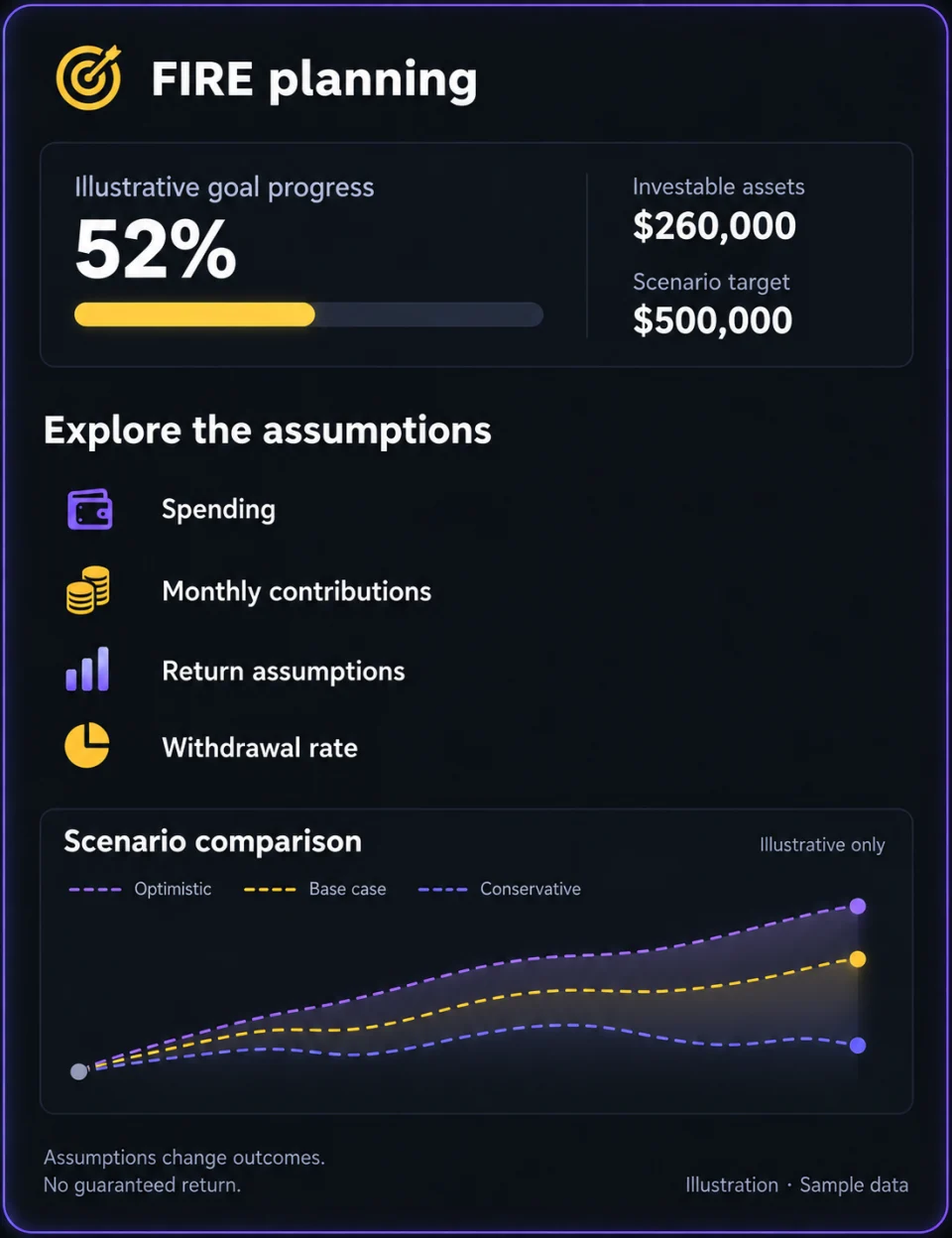
Most people track FIRE in a spreadsheet or a one-off calculator. The balance is right on the day it is typed in, and the plan quietly drifts as prices move, spending rises and contributions change.
In 1cc.ai, FIRE progress is measured from the net assets in your account: the stocks, ETFs, options, gold, US Treasuries and cash you record, minus credit-card balances and loans. Ongoing monthly expenses set the spending target, and recurring income minus recurring expenses sets the monthly net contribution.
Ongoing monthly expenses set current spending. Choose a lean, current, comfortable or abundant scenario and a 3%, 3.5% or 4% withdrawal rate to set target assets.
Recurring income minus recurring expenses sets the monthly net contribution. The app estimates the month and age your assets reach the target, in today's money.
From the FIRE month, salary stops and expenses come out of assets, while other planned income such as rent, dividends or a pension continues on its own dates.
See the share of target assets reached, the amount remaining and the time left to the target month.
Try a higher or lower monthly investment and see how many months or years the estimated FIRE date moves.
Add a planned purchase to Wishes and see whether it moves your estimated FIRE month, and by about how long.
Choose a spending scenario from lean to abundant and a 3–4% withdrawal rate to set target assets. See the estimated FIRE month and age in today's money, test a monthly contribution change, and check how long assets last after salary stops.
Ongoing monthly expenses set the current spending level for FIRE, and recurring income minus recurring expenses sets the monthly net contribution. Balances in other currencies are converted with the exchange rate shown.
It measures how close your assets are to the amount that could fund your spending, and estimates when you could get there. 1cc.ai does this from the holdings, cash and recurring cash flow you record.
No. You enter holdings, balances and recurring income and expenses manually. 1cc.ai does not sync bank or brokerage accounts or place trades.
Lean (0.7× current spending), current, comfortable (1.5×) and abundant (2×), each with a 3%, 3.5% or 4% withdrawal rate.
Yes. FIRE planning is a core feature and free forever. 1cc.ai is free to download on iOS and Android; Pro is an optional subscription for AI and advanced option analysis.
No. A FIRE projection is a scenario built on assumed returns and inflation, not a forecast or a guaranteed return. Markets do not deliver a constant return.